

What Was The Chemical Makeup Of The Cambrian Period
The Cambrian Catamenia
The Cambrian Menstruation marks an important point in the history of life on Earth; information technology is the fourth dimension when most of the major groups of animals first appear in the fossil record. This event is sometimes called the "Cambrian Explosion," because of the relatively short time over which this diversity of forms appears. It was once thought that Cambrian rocks contained the first and oldest fossil animals, but these are at present found in the earlier Ediacaran (Vendian) strata.
Life
Almost every metazoan phylum with hard parts, and many that lack difficult parts, made its starting time appearance in the Cambrian. The simply modern phylum with an acceptable fossil record to appear later on the Cambrian was the phylum Bryozoa, which is not known earlier the early Ordovician. A few mineralized animal fossils, including sponge spicules and probable worm tubes, are known from the Ediacaran Period immediately preceding the Cambrian. Some of the odd fossils of the biota from the Ediacaran may also have been animals representative of living phyla, although this remains a somewhat controversial topic. Still, the Cambrian was nonetheless a time of great evolutionary innovation, with many major groups of organisms appearing within a bridge of but 40 million years. Trace fossils made by animals also evidence increased diversity in Cambrian rocks, showing that the animals of the Cambrian were developing new ecological niches and strategies — such as active hunting, burrowing deeply into sediment, and making complex branching burrows. Finally, the Cambrian saw the advent and/or diversification of mineralized algae of various types, such every bit the coralline cherry-red algae and the dasyclad green algae.
This does non hateful that life in the Cambrian seas would accept been perfectly familiar to a modern-day SCUBA diver! Although virtually all of the living marine phyla were present, most were represented by classes that have since gone extinct or faded in importance. For case, the Brachiopoda was present, merely greatest diversity was shown past inarticulate brachiopods (similar the one pictured below, left). The articulate brachiopods, which would dominate the marine environment in the afterwards Paleozoic, were still relatively rare and not peculiarly diverse. Cambrian echinoderms were predominantly unfamiliar and strange-looking types such equally early edrioasteroids, eocrinoids, and helicoplacoids. The more familiar starfish, breakable stars, and sea urchins had non yet evolved, and there is some controversy over whether crinoids (body of water lilies) were present or non. Even if nowadays, crinoids were rare in the Cambrian, although they became numerous and various through the later Paleozoic. And while jawless vertebrates were present in the Cambrian, it was not until the Ordovician that armored fish became mutual plenty to leave a rich fossil tape.
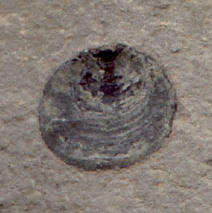 |  | 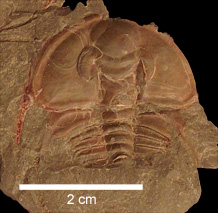 | | 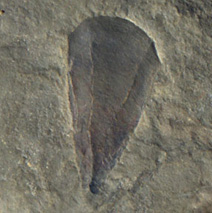 |
| Left: Acrothele, a adequately common inarticulate brachiopod from the the Wheeler Shale of western Utah. Centre: Olenellus fremontii from the Latham Shale of southern California. Right: A hyolith, as well from the Latham Shale. | ||||
Other dominant Cambrian invertebrates with difficult parts were trilobites (like the one pictured in a higher place), archaeocyathids (relatives of sponges that were restricted to the Lower Cambrian), and problematic conical fossils known as hyolithids (similar the ane pictured higher up, right). Many Early on Cambrian invertebrates are known just from "small-scale shelly fossils" — tiny plates, scales, spines, tubes, and and so on. Many of these were probably pieces of the skeletons of larger animals.
A few localities around the world that preserve soft-bodied fossils of the Cambrian bear witness that the "Cambrian radiation" generated many unusual forms not easily comparable with annihilation today. The best-known of these sites is the legendary Burgess Shale (heart Cambrian) in the British Columbian Rocky Mountains. Sites in Utah, southern Communist china, Siberia, and northward Greenland are also noted for their unusually good preservation of non-mineralized fossils from the Cambrian. One of these "weird wonders", first documented from the Burgess Shale, is Wiwaxia, depicted at lower left. Wiwaxia was an inch-long, creeping, scaly and spiny bottom dweller that may have been a relative of the molluscs, the annelids, or possibly an extinct fauna grouping that combined features of both phyla.
Stratigraphy
A lot can happen in 40 million years, the approximate length of the Cambrian Period. Animals showed dramatic diversification during this flow of Globe'due south history. This has been called the "Cambrian Explosion". When the fossil record is scrutinized closely, it turns out that the fastest growth in the number of major new animal groups took identify during the as-yet-unnamed second and third stages (by and large known equally the Tommotian and Atdabanian stages) of the early Cambrian, a period of near 13 one thousand thousand years. In that time, the first undoubted fossil annelids, arthropods, brachiopods, echinoderms, molluscs, onychophorans, poriferans, and priapulids bear witness upwardly in rocks all over the world.
Stratigraphic boundaries are by and large determined past the occurences of fossils. For case, the trace fossil Treptichnus pedum marks the base of the Cambrian. This purlieus is an unusual case, since stratigraphic boundaries are normally defined by the presence or absence of groups of fossils, chosen assemblages. In fact, much paleontological work is concerned with questions surrounding when and where stratigraphic boundaries should exist defined. At start glance, this may non seem like important work, but consider this: if yous wanted to know about the evolution of life on World, yous would need a fairly accurate timeline. Questions such equally: "how long did something stay the aforementioned?" or,"how fast did it alter?" can just exist assessed in the context of time.
Tectonics and paleoclimate
The Cambrian follows the Ediacaran Period, during which time the continents had been joined in a unmarried supercontinent called Rodinia (from the Russian word for "homeland", rodina). Every bit the Cambrian began, Rodinia began to fragment into smaller continents, which did non always correspond to the ones we see today. The reconstruction below shows the rifting of Rodinia during the second stage (Tommotian) of the Cambrian . Light-green represents state higher up water at this fourth dimension, red indicates mountains, light blueish indicates shallow seas of the continental shelves, and dark blue denotes the deep body of water basins. (For clarity, the outlines of nowadays-solar day continents have been superimposed on the map.)
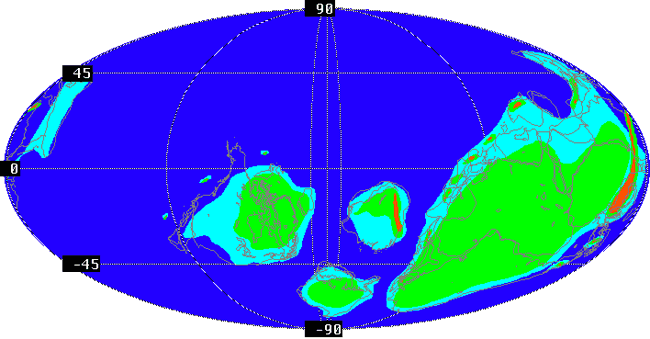
Earth climates were mild; there was no glaciation. Landmasses were scattered as a result of the fragmentation of the supercontinent Rodinia that had existed in the late Proterozoic. Most of Due north America lay in warm southern tropical and temperate latitudes, which supported the growth of extensive shallow-water archaeocyathid reefs all through the early Cambrian. Siberia, which also supported arable reefs, was a separate continent due east of North America. Baltica — what is now Scandinavia, eastern Europe, and European Russia — lay to the south. Most of the rest of the continents were joined together in the supercontinent Gondwana, depicted on the right side of the map; South America, Africa, Antarctica, India, and Australia are all visible. What is now China and east Asia was fragmented at the time, with the fragments visible north and west of Australia. Western Europe was also in pieces, with most of them lying northwest of what is at present the northward African coastline. The present-day southeastern The states are visible wedged between South America and Africa; they did not become part of N America for another 300 million years. Tectonism affected regions of Gondwana, primarily in what are now Australia, Antarctica, and Argentine republic. The continental plate movement and collisions during this period generated pressure level and heat, resulting in the folding, faulting, and crumpling of rock and the formation of big mountain ranges.
The Cambrian world was bracketed between two ice ages, one during the late Proterozoic and the other during the Ordovician. During these ice ages, the subtract in global temperature led to mass extinctions. Libation conditions eliminated many warm h2o species, and glaciation lowered global sea level. However, during the Cambrian there was no significant ice formation. None of the continents were located at the poles so land temperatures remained mild. In fact, global climate was probably warmer and more compatible than it is today. With the retreat of Proterozoic ice, the ocean level rose significantly. Lowland areas such as Baltica were flooded and much of the world was covered by epeiric seas. This effect opened up new habitats where marine invertebrates, such as trilobites, radiated and flourished.
Plants had not yet evolved, and the terrestrial world was devoid of vegetation and inhospitable to life equally we know it. Photosynthesis and main production were the monopoly of bacteria and algal protists that populated the world'due south shallow seas.
Also during the Cambrian, the oceans became oxygenated. Although there was plentiful atmospheric oxygen past the first of the period, information technology wasn't until the Cambrian that there was a sufficient reduction in the number of oxygen-depleting bacteria to permit higher oxygen levels in the waters. This dissolved oxygen may accept triggered the "Cambrian Explosion" — when most of the major groups of animals, peculiarly those with hard shells, outset appeared in the fossil record.
Localities
-
Aldan River, Siberia,: This early Cambrian creature tells us nearly the early evolution of animals with skeletons.
-
Burgess Shale, British Columbia: Thousands of soft-bodied creature fossils paint us a picture show of early marine life.
-
House Range, Utah: An assortment of Cambrian critters has been found in the Wheeler Shale and the Marjum Germination.
-
Marble Mountains, California: Olenellid trilobites and more are establish in this Mojave Desert locality.
-
White-Inyo Mountains, California: Visit ancient Cambrian reefs in these mountains of eastern California.
Resources
- Observe out more about the Cambrian paleontology and geology of N America at the Paleontology Portal.
- See the Wikipedia folio on the Cambrian.

What Was The Chemical Makeup Of The Cambrian Period,
Source: https://ucmp.berkeley.edu/cambrian/cambrian.php
Posted by: leehaturat.blogspot.com
0 Response to "What Was The Chemical Makeup Of The Cambrian Period"
Post a Comment